
Key takeaways
- Traditional time-based RSUs vest on schedule no matter what happens to the stock price. In our analysis of Russell 3000 companies that IPO’d after 2010, 41% of scheduled vesting events occurred while the stock traded below its grant price.
- The Price-Protected RSU keeps everything about a traditional RSU the same, except one thing: at each vest date, the tranche only vests if the stock price has held at or above the grant-date price.
- Missed tranches aren’t forfeited outright. They carry forward and remain eligible to vest later. Most eventually would have vested in the same analysis noted above; only 16% were ultimately forfeited assuming a three-year quarterly design with a two-year grace period.
- The design flexes by population: longer grace periods and carry-forward windows for broad-based grants, tighter parameters for executive awards.
Over the past two decades, time-based restricted stock units have become the dominant form of equity compensation for late-stage private and public companies. Their rise was no accident. As organizations moved beyond stock options, RSUs offered a simpler and more predictable way to deliver long-term equity: easier for employees to understand, more straightforward to administer, and effective across broad populations while remaining flexible enough for executive programs.
This mirrors a broader shift in the market. In 2000, virtually all public companies granted stock options, and only 20% granted service-based full-value awards like RSUs. By 2024, those numbers had essentially reversed: virtually all public companies granted service-based full-value awards, and just over 40% still granted options.1
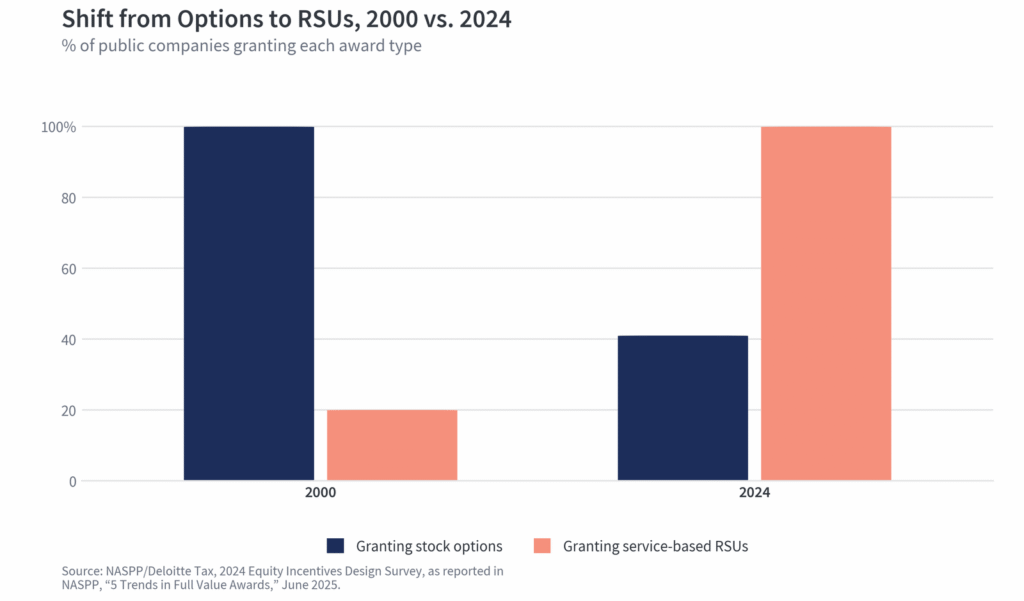
| Award Year | 2000 | 2024 |
|---|---|---|
| % granting stock options | 100% | 41% |
| % granting service-based RSUs | 20% | 100% |
Few practitioners would question their role as the foundation of most equity programs. For many companies, they remain the right award.
Years of widespread adoption, however, have also produced something equally valuable: experience. After designing and administering RSU programs across multiple market cycles, several recurring situations have become difficult to ignore. They do not suggest the traditional time-based RSU is flawed. They reflect the reality that every equity design is built on a set of assumptions, and assumptions are worth revisiting as markets move and governance expectations evolve.
One assumption is worth examining directly: in our analysis of Russell 3000 companies that went public after 2010, modeling a three-year quarterly vesting schedule against their actual stock price histories, approximately 41% of scheduled vesting events occurred while the stock traded below its grant-date price.2
Under a traditional RSU, every one of those tranches vested anyway. And in many cases, created unintended consequences.
These lessons paved the road to the Price-Protected RSU: a design feature that preserves the simplicity, service-based vesting, and broad applicability that have made RSUs successful, while introducing one additional safeguard for situations where automatic vesting may not serve the interests of the company, the employee, shareholders, or all three.
In short: a Price-Protected RSU is a time-based RSU that adds one condition at each vest date. Shares are delivered only if the stock price has held at or above the grant-date price. If it hasn’t, the tranche is deferred, not forfeited, and stays eligible to vest later.
Where Automatic Vesting Creates Unintended Outcomes
The success of the time-based RSU stems from its predictability. Employees provide service, the schedule progresses, and shares are delivered on pre-determined dates.
That same predictability creates challenges under specific circumstances. The four situations below look different on the surface, but each traces back to the same design characteristic: vesting occurs on schedule regardless of what has happened to the stock price.
1. The “Rest and Vest” Criticism
Time-based RSUs reward continued service, not company performance. That distinction contributed to their widespread adoption. It has also fueled the most common criticism leveled against them: shares vest regardless of whether shareholder value has increased, held flat, or declined.
The criticism is sharpest in executive compensation, where alignment receives the most scrutiny. When a company has materially underperformed over several years, automatic vesting creates the perception that awards were earned through the passage of time rather than the creation of value.
This does not mean time-based awards should become performance awards. It raises a narrower question: should sustained stock-price declines influence when shares are delivered?
2. Settlement Decisions During Challenging Times
A less visible challenge emerges when RSUs vest into a depressed stock price or when a company’s public float and trading volume are low.
Companies must satisfy employee tax withholding at each vest date. In practice, that means choosing between two imperfect approaches. Sell-to-cover pushes shares into a market already under pressure, increasing dilution and creating unfavorable optics. Net share withholding avoids the sale but draws cash off the balance sheet, often at precisely the moment liquidity matters most.
Neither outcome is ideal. Under a traditional RSU, companies have no flexibility, because vesting proceeds automatically. And as the 41% figure above suggests, this is not an edge case for newly public companies. It is a common, frequently recurring decision.
3. The Grant Guideline Conundrum
Most equity programs set grant guidelines in dollars rather than shares. A company intends to deliver $100,000 of long-term incentive value, and the share count follows from the grant-date price.
If the stock declines materially before vesting, the employee receives every scheduled share, but the value delivered falls well below what both parties understood the award to represent.
The result is friction on both sides. Employees feel they received less than promised. Companies are left explaining that the award guaranteed a share count, not a dollar value. The retention objective survives on paper; the economic outcome no longer reflects the original intent.
4. An Emerging Executive Governance Gap
The final consideration reflects a shifting governance landscape.
For years, many public companies leaned heavily on performance stock units to demonstrate pay-for-performance alignment, even when setting meaningful multi-year metrics proved difficult. Proxy guidance has since evolved, and long-vesting time-based equity now qualifies as an acceptable executive incentive structure.
That flexibility creates a new question. When executives receive RSUs that continue to vest through a sustained decline in shareholder value, boards will face questions about why. For companies seeking a stronger governance narrative, automatic vesting no longer provides a complete answer.
Even among large, mature companies, the situation arises often enough to be vulnerable to criticism.
A Common Design Challenge
Although these situations look different, they all expose the same design characteristic embedded in every traditional RSU: vesting occurs on schedule regardless of what has happened to the stock price.
In most circumstances, that simplicity is a strength. But when stock prices remain depressed for an extended period, automatic vesting can create tension between retention objectives, shareholder expectations, settlement decisions, and employee outcomes.
That observation led to a simple design question: can companies preserve the strengths of the traditional time-based RSU while introducing flexibility around when shares are earned and the value delivered?
A Different Way to Think About Vesting
The Price-Protected RSU is built on a straightforward principle: preserve everything that has made the time-based RSU successful, and add one check before shares are delivered.
At each scheduled vest date, the award asks a single question:
Has the company’s stock price maintained at least the value established when the award was granted?
If yes, the tranche vests exactly as it would under a traditional RSU.
If no, the tranche is deferred rather than delivered. It remains eligible to vest at a future scheduled vest date if the price condition is satisfied, subject to the award’s carry-forward and grace-period provisions.
Everything else stays the same. Employees continue earning the award through service. The award remains time-based and familiar to administer. The only variable is when shares are delivered.
This is an evolution of the traditional time-based RSU, not a replacement.
Why the Carry-Forward Matters
The carry-forward provision is what separates the Price-Protected RSU from a conventional market-condition award. Without it, the design is simply another vesting hurdle. With it, the philosophy changes.
Stock prices fluctuate. A temporary decline does not reflect the long-term trajectory of the business or the value an employee created through continued service. Rather than forcing an immediate outcome, vesting well below the intended value or forfeiting outright, the missed tranche stays outstanding and remains eligible at future vest dates.
The distinction matters economically, not just philosophically. Returning to the Russell 3000 analysis: of the 41% of tranches that missed their scheduled date, most eventually cleared. Under a three-year quarterly design with a two-year grace period, roughly 25% of all tranches vested late and approximately 16% were ultimately forfeited.
Put differently, the carry-forward converted the substantial majority of missed vesting events into deferred delivery rather than lost value.
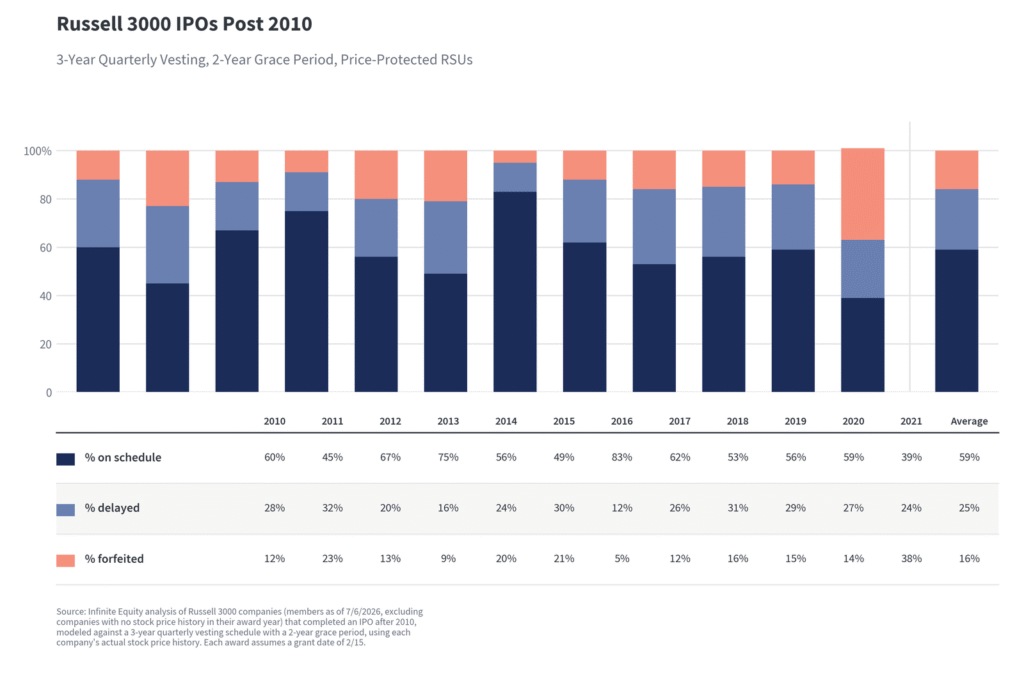
| Award Year | 2010 | 2011 | 2012 | 2013 | 2014 | 2015 | 2016 | 2017 | 2018 | 2019 | 2020 | 2021 | Avg. |
|---|---|---|---|---|---|---|---|---|---|---|---|---|---|
| % on schedule | 60% | 45% | 67% | 75% | 56% | 49% | 83% | 62% | 53% | 56% | 59% | 39% | 59% |
| % delayed | 28% | 32% | 20% | 16% | 24% | 30% | 12% | 26% | 31% | 29% | 27% | 24% | 25% |
| % forfeited | 12% | 23% | 13% | 9% | 20% | 21% | 5% | 12% | 16% | 15% | 14% | 38% | 16% |
One Design Principle. Two Different Applications.
The underlying principle holds regardless of employee population. What changes is calibration.
For broad-based programs, the emphasis falls on improving long-term employee outcomes while reducing difficult settlement decisions during depressed periods. Longer carry-forward windows and more generous grace periods preserve retention value and allow employees to participate in a recovery.
Executive awards serve a different objective. The same principle strengthens shareholder alignment and provides boards with an additional governance consideration as they evaluate long-vesting-period equity alongside traditional PSU structures. Tighter parameters, including shorter carry-forward windows, limited or no grace periods, and explicit forfeiture risk, reinforce that intent.
The Price-Protected RSU is not a one-size-fits-all solution. It is a framework calibrated to company stage, volatility, governance priorities, employee population, and overall equity strategy.
A Practical Addition to the Equity Design Toolkit
Time-based RSUs have earned their place as the foundation of modern equity compensation. Their simplicity, predictability, and broad applicability have made them one of the most successful award designs of the past two decades.
The Price-Protected RSU builds on that foundation by asking a practical question: can companies preserve the strengths of the traditional time-based RSU while introducing a modest amount of flexibility for situations where automatic vesting does not produce the intended outcome?
In our experience, yes, though like any equity design, it will fit some organizations better than others. Its value is that it gives practitioners another option when automatic vesting no longer produces the outcomes they want, refining a proven design rather than replacing it.
Perhaps the next evolution of the time-based RSU begins with a simple question asked before every vesting event:
Does every vesting event need to occur automatically?
For many companies, the answer will continue to be yes. For others, a modest amount of built-in flexibility may better align equity design with shareholder expectations, employee outcomes, and long-term program objectives. These are exactly the kinds of design questions practitioners should be asking.
In the next article, we examine the mechanics of the design, including how each element works, what the accounting treatment is under ASC 718, and the valuation implications companies should understand before implementation.
If your organization is evaluating its equity strategy, or simply exploring different ways to think about time-based awards, we welcome the opportunity to continue the conversation.
- Percentage of public companies granting stock options and service-based full-value awards, 2000 vs. 2024. Source: NASPP/Deloitte Tax, 2024 Equity Incentives Design Survey, as reported in NASPP, “5 Trends in Full Value Awards,” June 2025, naspp.com/blog/5-trends-in-full-value-awards ↩︎
- Analysis covers companies currently in the Russell 3000 that completed an IPO after 2010, modeled against a three-year quarterly vesting schedule using actual historical stock prices. Because the sample is drawn from current index constituents, it excludes companies that were acquired or delisted, which likely understates the frequency of below-grant-price vesting events across the full IPO cohort. ↩︎
Frequently Asked Questions
A Price-Protected RSU is a time-based restricted stock unit with one added condition. At each scheduled vest date, the tranche only vests if the company’s stock price has held at or above the price on the grant date. If the price is below grant, the tranche is deferred rather than delivered, and it remains eligible to vest at a later date under the award’s carry-forward and grace-period provisions.
They are identical in every respect except one. A traditional RSU vests automatically on schedule no matter what the stock price has done. A Price-Protected RSU adds a single price-maintenance check at each vest date. If the stock is trading below the grant date price, delivery is deferred, not canceled.
While the award remains a time-based, service-vesting award, the stock price hurdle does introduce a market condition, which requires a Monte Carlo valuation. We’ll dive deeper into these implications in subsequent articles.
The deferred tranche remains outstanding through the award’s carry-forward window and grace period. If the price condition still isn’t met once that window closes, the tranche is forfeited. In our Russell 3000 analysis, about 16% of tranches that missed their scheduled vest date were ultimately forfeited under a three-year quarterly design with a two-year grace period. The rest eventually vested late.
Indirectly, yes. By deferring vesting during a depressed stock price, it also defers the sell-to-cover or net-share-withholding decision that would otherwise force a dilutive sale or a cash outlay at an inopportune time.
Both, with different calibrations. Broad-based programs typically use longer carry-forward windows and more generous grace periods to protect retention value. Executive awards typically use tighter parameters: shorter carry-forward windows, and little or no grace period, to reinforce shareholder alignment.
Follow Along
This is the first article in a 6-part series on the Price-Protected RSU. Enter your details below and we’ll send each new article straight to your inbox.
About the Authors

Jon Burg
Managing Partner
Jon Burg is Managing Partner and a practice leader at Infinite Equity, based in San Francisco. He works with companies to build equity programs that support long-term employee ownership, from initial design through full execution. With more than 20 years in the field and an actuarial background, he brings added rigor to how equity compensation programs are designed, valued, and implemented. Jon is a graduate of the University of Washington.

Daniella Butler, FSA, CEP
Managing Director
Daniella Butler is a Managing Director at Infinite Equity in New York City. She holds the FSA (Fellow of the Society of Actuaries) and CEP designations and has spent more than 10 years advising on compensation and benefits, with particular expertise in equity strategy, design, and valuation. She is a graduate of Hofstra University.