Key takeaways
- Every Price-Protected RSU is built from the same six components: base price, scheduled tranches, price check, carry-forward, grace period, and final expiration.
- The most consequential design decision is how carry-forward works. Per-tranche windows give every missed tranche the same fixed recovery period; a single terminal date gives all missed tranches eligibility through one common date. The two constructions produce different awards with different valuations.
- Whatever method sets the base price, spot price or a trailing average, must also be used to measure the price at each check. Mismatching the two introduces a systematic bias.
- For private companies, the price check should align to the valuation refresh cadence rather than defaulting to quarterly checks against a 409A that hasn’t moved.
- Award agreements need to explicitly address termination, change in control, and capital structure events like special dividends, since the default outcome can penalize employees for a company action that didn’t destroy shareholder value.
Our first article introduced the Price-Protected RSU and the situations that motivated it. This article is the reference: what each design element does, how the elements interact, and the decisions that have to be made explicitly before the first grant.
The concept is simple enough to explain in a sentence. The mechanics are not. Several choices that appear procedural — how the base price is measured, whether carry-forward runs per tranche or to a fixed date, what happens on termination — materially change how the award behaves and what it is worth.
This article works through those choices without assuming a particular answer.
The Six Elements
Every Price-Protected RSU is built from the same six components.
| Element | Definition |
|---|---|
| Base Price | The minimum stock price threshold, established at grant and fixed for the life of the award |
| Scheduled Tranches | The service-based vesting schedule, unchanged from a traditional RSU |
| Price Check | The comparison of current price to base price, performed at each scheduled vest date |
| Carry-Forward | The provision allowing a tranche that fails its price check to remain eligible at later dates |
| Grace Period | An additional recovery window following the final scheduled vest date |
| Final Expiration | The date on which any tranche still outstanding lapses |

The first three elements have a rough counterpart in any market-condition award: a TSR design, for instance, compares a beginning price to an ending price, even though it doesn’t use this terminology or check that comparison at multiple scheduled dates the way this design does. The last three elements are what distinguish this design, and they are where most of the consequential decisions sit.
Base Price
The base price is the threshold the stock must meet or exceed for a tranche to vest. It is set once, at grant, and does not move.
For public companies, it is typically the grant-date fair market value. For late-stage private companies, it is typically the 409A valuation in effect at grant.
Measurement method. Two approaches are common:
Spot price uses the closing price on the grant date. It is simple, unambiguous, and easy to document.
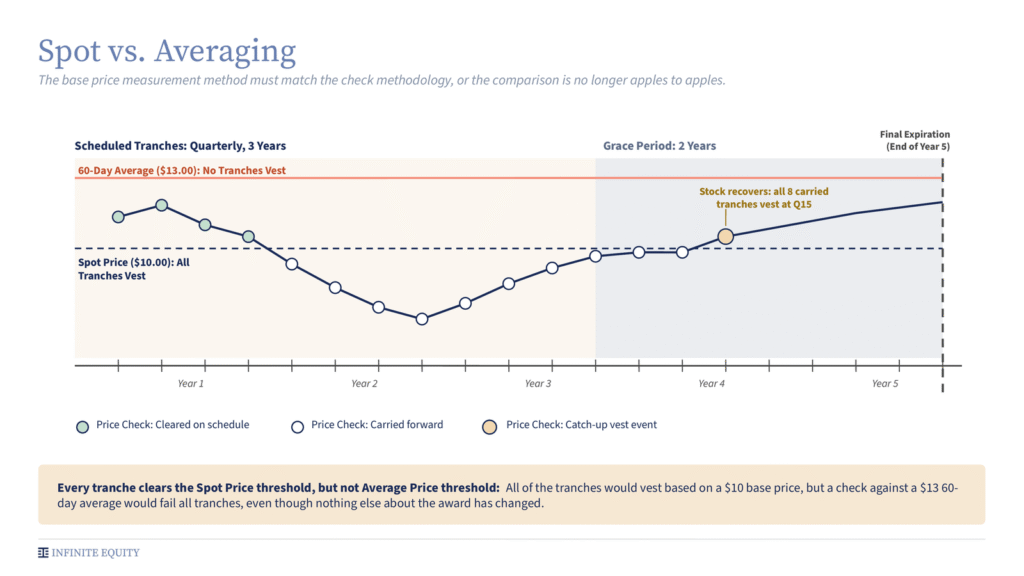
Averaging period uses a trailing average, commonly twenty or thirty trading days, though the exhibit below stretches that to sixty days to make the distortion easier to see. This dampens the effect of a single unusual trading day and often aligns with how the company already sizes grants under its guidelines.
Neither is superior. Companies that size grants using an averaging convention will generally find it cleaner to set the base price the same way.
The methodology must match at both ends. This is the point most often missed. Whatever method establishes the base price must also be used to determine the current price at each check.
Setting a base price on a twenty-day average and then testing against a single closing price introduces a systematic asymmetry. The two figures are measuring different things, and the mismatch will favor one side depending on trend direction. Pairing spot with spot, or average with average, keeps the comparison honest.
Setting the base price below grant price. Some companies consider a base price at a discount to grant-date value, 80% or 90%, so the check binds only on a material decline rather than any decline. This is a legitimate design choice that softens the award considerably and raises grant-date fair value. It is more common in broad-based programs than executive ones, where the governance signal depends on the hurdle sitting at grant price.
Scheduled Tranches and Check Frequency
The vesting schedule itself does not change. Whatever cadence the company already uses — monthly, quarterly, or annual, with or without a cliff — carries over.
What the design adds is a check at each of those dates. Frequency matters more than it first appears.
More frequent checks produce more vesting opportunities. A tranche that fails its check in a quarterly design has another opportunity in three months. In an annual design, it waits a year. Across a full schedule, quarterly checks create four times as many chances to clear the hurdle as annual checks.
That has three consequences: it raises grant-date fair value, because probability of eventual satisfaction is higher; it reduces the average delay between a missed tranche and its eventual delivery; and it increases administrative load, since each check is a discrete event requiring measurement, documentation, and participant communication.
Broad-based programs commonly use quarterly checks. Executive programs commonly use annual checks: fewer, more meaningful checkpoints that align with the governance narrative and reduce the chance of a tranche clearing on a brief spike.
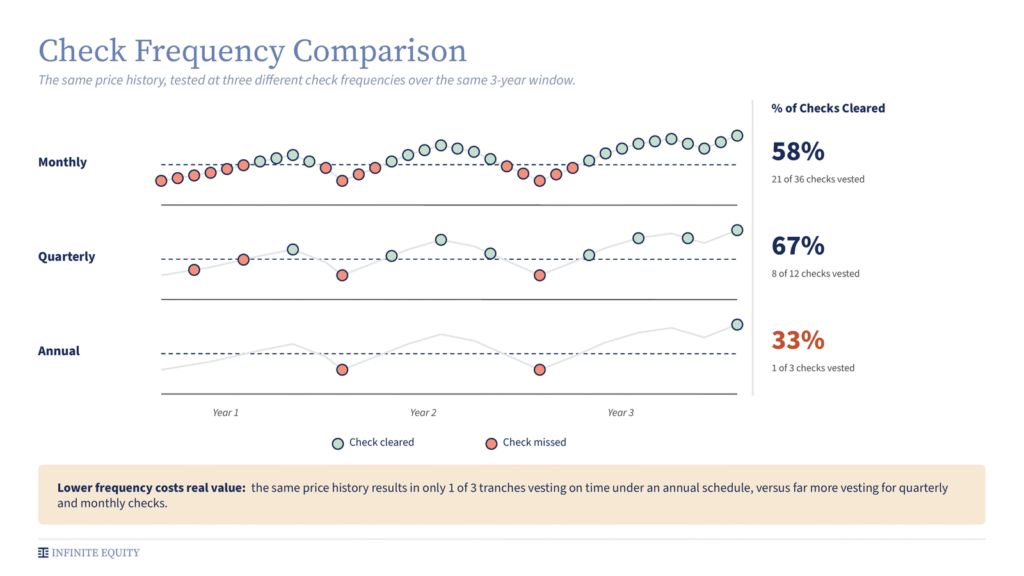
| Check frequency | Checks vested | % of checks cleared |
|---|---|---|
| Monthly | 21 of 36 | 58% |
| Quarterly | 8 of 12 | 67% |
| Annual | 1 of 3 | 33% |
Decoupling service vesting from check frequency means nothing requires the two to match. A company can maintain quarterly service vesting while performing the price check annually. Tranches accumulate between checks and resolve together.
This is unusual in public company designs but becomes important for private companies, discussed below.
The Price Check
At each scheduled vest date, the current price is compared to the base price.
If current price is greater than or equal to the base price, the tranche vests exactly as a traditional RSU would. Shares are delivered, tax withholding is settled, and the tranche is closed.
If current price is below the base price, the tranche does not vest. It is not forfeited. It carries forward.

Two mechanical points worth stating explicitly.
The check is evaluated independently at each date. A tranche that fails in Q3 has no bearing on whether the Q4 tranche clears. Each date is assessed on its own.
Carried tranches settle together with the current tranche. When a check is satisfied, every eligible carried tranche vests alongside the scheduled one. If four tranches have accumulated and the fifth check clears, five tranches worth of shares deliver at once. This creates a concentrated settlement event with corresponding tax withholding, worth anticipating in cash planning and in participant communication.
Carry-Forward: The Decision That Matters Most
Carry-forward is what separates this design from a conventional market-condition award. Without it, a missed check means forfeiture. With it, a missed check means delay.
The consequential question is how long eligibility lasts, and there are two constructions.
Per-tranche windows
Each missed tranche remains eligible for a fixed number of periods measured from its own scheduled vest date.
A tranche missed at Q3 with a four-quarter window remains eligible through Q7. A tranche missed at Q9 remains eligible through Q13. Every tranche receives identical treatment regardless of when it was scheduled.
It’s the more equitable construction, though also more complex to administer, since each outstanding tranche carries its own expiration date, and later tranches can remain eligible well past the end of the vesting schedule.
Single terminal date
All missed tranches remain eligible through one common date, typically the final scheduled vest date plus any grace period.
This is simpler to administer, simpler to communicate, and resolves all outstanding tranches at once. It is the construction used in most of our illustrations.
It also produces a meaningful asymmetry: a tranche missed early receives a long recovery window, while a tranche missed near the end receives a short one. Under a terminal-date construction with no grace period, the final scheduled tranche has no carry-forward at all. It must clear on its scheduled date or lapse immediately.
That asymmetry is not necessarily a flaw. For executive designs it arguably reinforces the governance signal, since the final tranche becomes a clean test of where the stock stands at the end of the performance horizon. But it should be a deliberate choice rather than an artifact.

Both constructions are defensible, but neither is standard, so the award agreement must say which one governs, in language that leaves no room for interpretation.
Grace Period and Final Expiration
These two elements are frequently conflated. They serve different functions.
The grace period is an additional window following the final scheduled vest date during which carried tranches remain eligible. It extends the opportunity for recovery beyond the end of the vesting schedule.
Final expiration is the date on which any tranche still outstanding lapses permanently.
Under a terminal-date carry-forward construction, these collapse into a single date: final scheduled vest plus grace period equals final expiration. Under a per-tranche construction they remain distinct, and final expiration functions as an outside backstop preventing individual tranches from remaining outstanding indefinitely.
Grace period length is typically the last lever companies set, and it is the one most directly connected to program philosophy. Broad-based programs commonly use one to two years, reflecting an emphasis on preserving employee opportunity. Executive programs commonly use a short window or none, reflecting an emphasis on forfeiture as a governance signal.
A Complete Worked Example
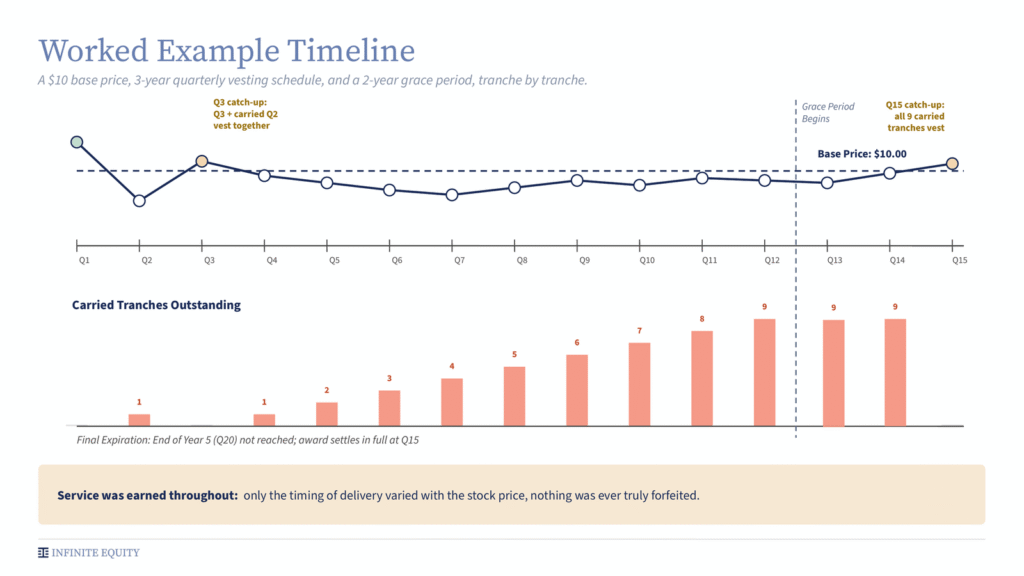
Consider an award granted when the stock trades at $10.00, vesting in twelve equal quarterly tranches over three years. The base price is $10.00. Carry-forward runs to a single terminal date. A two-year grace period applies, so final expiration falls at the end of Year 5.
Q1: stock at $11.20. The check is satisfied. The tranche vests normally.
Q2: stock at $8.75. Below base price, so the tranche carries forward rather than vesting at a loss.”
Q3: stock at $10.40. Clearing the check, so both the Q3 tranche and the carried Q2 tranche vest together, two tranches settling at once.
Q4 through Q11: stock below $10.00 throughout. Eight consecutive checks fail. All eight tranches carry forward and accumulate.
Q12: Q12 arrives as the final scheduled vest date, with the stock at $9.60. The check fails again, bringing the accumulated pool to nine outstanding tranches just as the vesting schedule ends and the grace period begins.
Q15: stock at $10.30. The check is satisfied during the grace period. All nine carried tranches vest simultaneously.
Throughout, the employee earned the award through continued service. The only variable was when shares were delivered. The shares that were ultimately delivered were worth at least the value the grant originally contemplated.
| Vest date | Outcome | Carried tranches outstanding after |
|---|---|---|
| Q1 | Cleared | 0 |
| Q2 | Missed | 1 |
| Q3 | Cleared (Q3 + carried Q2 vest together) | 0 |
| Q4 | Missed | 1 |
| Q5 | Missed | 2 |
| Q6 | Missed | 3 |
| Q7 | Missed | 4 |
| Q8 | Missed | 5 |
| Q9 | Missed | 6 |
| Q10 | Missed | 7 |
| Q11 | Missed | 8 |
| Q12 | Missed (final scheduled vest date; grace period begins) | 9 |
| Q15 | Cleared during grace period; all 9 carried tranches vest | 0 |
Had the stock never recovered above $10.00 before the end of Year 5, the nine outstanding tranches would have lapsed and returned to the share reserve.
Private Company Considerations
The design translates to late-stage private companies with one mechanical problem that requires resolution.
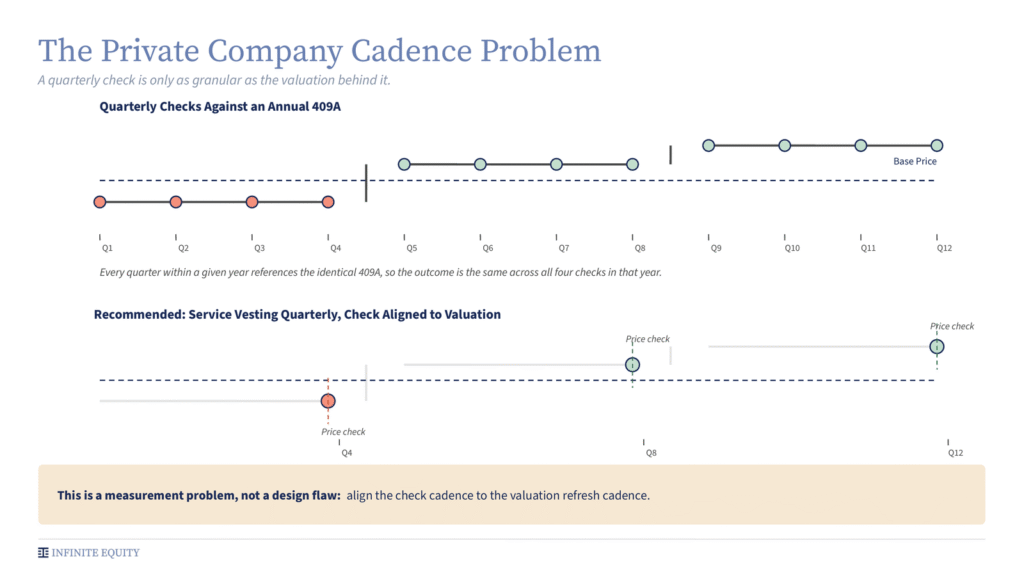
A quarterly price check requires a quarterly current price. Most private companies refresh their 409A valuation annually, or semi-annually at most.
Comparing a quarterly vest date against a 409A that has not moved in nine months produces an unhelpful result: three consecutive checks reference the identical price, so either all three clear or none do. The granularity that makes quarterly checks useful disappears entirely.
Our recommendation is to align the price check cadence to the valuation refresh cadence. Service vesting can remain quarterly. Only the check needs to match the valuation cycle. Tranches accumulate between valuations and resolve when a new 409A is issued.
Companies with more frequent valuation events — secondary transactions, tender offers, priced rounds — may support a more frequent check, provided the reference price reflects a genuine independent measurement rather than a stale carryforward.
One further observation. Because 409A valuations generally step upward over time at a healthy company, the price check is usually satisfied. The design binds primarily in down-round scenarios and in the run-up to a liquidity event where valuation expectations have compressed, which is precisely when the dilution and settlement problems it addresses are most acute.
Termination, Corporate Actions, and Edge Cases
Termination of employment
Most designs forfeit carried tranches immediately on termination, consistent with how unvested RSUs are already treated.
That treatment is clean, but it produces an outcome worth understanding. An employee who provided full service through Q8, whose Q5 through Q8 tranches all carried forward, and who then leaves at Q9, has completed the service requirement for four tranches and receives nothing for them. The service condition was met; the price condition was not.
Companies that find that outcome harsh have alternatives: a defined post-termination eligibility window, or different treatment for qualifying retirement, death, and disability. Each adds complexity and may raise deferred compensation questions where eligibility extends well past separation. Most companies will conclude that immediate forfeiture is the right answer, but it should be a conclusion rather than a default.
Stock splits and capital structure changes
The base price must adjust for stock splits, reverse splits, and similar changes. A two-for-one split halves the base price. This is mechanically obvious and still needs to be written down.
Spin-offs and significant special dividends are less obvious and deserve explicit treatment.
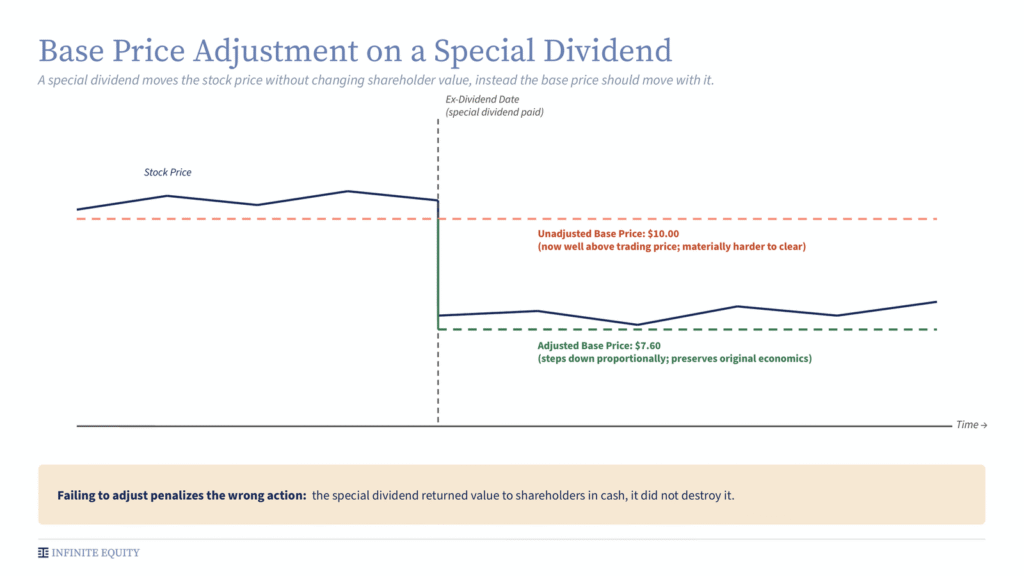
Special dividends warrant particular attention. A large special dividend reduces the share price without destroying shareholder value. Holders received the value in cash. If the base price does not adjust downward correspondingly, the price hurdle becomes permanently harder to clear as a direct consequence of returning capital to shareholders.
That is a perverse outcome. A design intended to align employees with shareholders should not penalize them when the company distributes value to shareholders. Award agreements should provide for base price adjustment on any distribution that substantially reduces share price outside of ordinary course dividends.
| Base price version | Value after ex-dividend date |
|---|---|
| Unadjusted | $10.00 (now well above trading price; materially harder to clear) |
| Adjusted | $7.60 (steps down proportionally; preserves original economics) |
Change in control
If a transaction closes while carried tranches remain outstanding, the award agreement must specify whether the price check is tested against the transaction consideration or waived, with the tranche treated as automatically satisfied.
Testing against deal price preserves the design’s internal logic. Waiving the check is simpler and more favorable to participants but eliminates the protection at the moment it would otherwise matter most.
This carries particular weight for executive awards, where the governance rationale is central. We address it in more detail in the executive article.
Documentation
Because this design differs from a conventional RSU in ways that are not obvious from the vesting schedule alone, award agreements need to be more explicit than usual.
At minimum, agreements should define:
- The base price and the measurement methodology used to establish it
- The price measurement approach at each check, matching the base price methodology
- Check frequency, and whether it matches the service vesting cadence
- Whether carry-forward runs per tranche or to a terminal date
- Grace period length and final expiration
- Treatment of carried tranches on termination, including any variation for retirement, death, or disability
- Treatment in a change in control, including whether the check tests against transaction consideration
- Base price adjustment for splits, spin-offs, special dividends, and other capital structure events
Companies should also confirm that the equity plan itself permits the design without amendment, and that their equity administration platform can track a carried tranche through a grace period. Neither is a given, and both are better established before design than after.
The test for adequate documentation is straightforward: employees, administrators, auditors, legal counsel, and the compensation committee should all read the agreement and reach the same conclusion about how the award behaves in every scenario above.
Closing Thoughts
The Price-Protected RSU is a framework rather than a fixed product. Every element described here is a choice, and the combination determines how the award behaves for the company, for the participant, and in the specific circumstances where it matters.
None of these choices is neutral. Each one changes what the award is worth, not as a matter of judgment but as a matter of arithmetic. A one-year carry-forward and an unlimited one produce measurably different grant-date fair values. So do quarterly checks and annual ones.
In our next article, we put figures on all of them: how each design lever affects grant-date fair value under Monte Carlo valuation, what ASC 718 classification means for expense recognition, and why Year 1 expense arrives at roughly twice the pace a straight-line schedule would suggest.
Frequently Asked Questions
Using either a spot price, the closing price on the grant date, or a trailing average, commonly 20 or 30 trading days. Whichever method sets the base price must also be used to measure the price at each check. Mismatching the two methods introduces a systematic bias.
It depends on the population. Broad-based programs commonly use quarterly checks, which raise grant-date fair value and shorten the average delay before a missed tranche clears. Executive programs commonly use annual checks: fewer, more meaningful moments that align with the governance narrative.
Per-tranche windows give every missed tranche the same fixed recovery period measured from its own vest date. A single terminal date gives all missed tranches eligibility through one common date, typically the final scheduled vest date plus any grace period. They produce different awards with different valuations, and the award agreement must specify which one applies.
Most designs forfeit carried tranches immediately on termination, consistent with how unvested RSUs are already treated. Companies that want a softer outcome can build in a defined post-termination eligibility window, or different treatment for retirement, death, and disability, though that adds complexity and may raise deferred compensation questions.
The recommended approach is to align the price check cadence to the company’s valuation refresh cadence rather than checking quarterly against a 409A that hasn’t moved. Service vesting can stay more frequently; only the price check needs to match the valuation cycle.
Yes. A large special dividend reduces the share price without destroying shareholder value, since holders received that value in cash. If the base price doesn’t adjust downward to match, the price hurdle becomes permanently harder to clear as a direct consequence of returning capital to shareholders, so award agreements should provide for a corresponding adjustment.
Follow Along
This is the second article in a 6-part series on the Price-Protected RSU. Enter your details below and we’ll send each new article straight to your inbox.
About the Authors

Jon Burg
Managing Partner
Jon Burg is Managing Partner and a practice leader at Infinite Equity, based in San Francisco. He works with companies to build equity programs that support long-term employee ownership, from initial design through full execution. With more than 20 years in the field and an actuarial background, he brings added rigor to how equity compensation programs are designed, valued, and implemented. Jon is a graduate of the University of Washington.

Daniella Butler, FSA, CEP
Managing Director
Daniella Butler is a Managing Director at Infinite Equity in New York City. She holds the FSA (Fellow of the Society of Actuaries) and CEP designations and has spent more than 10 years advising on compensation and benefits, with particular expertise in equity strategy, design, and valuation. She is a graduate of Hofstra University.