Key takeaways
- The price protection feature is a market condition under ASC 718. The award is valued with a Monte Carlo simulation at grant, and the expense for each tranche is recognized if the requisite service is provided, regardless of whether the base price condition is met or not.
- Expense is front-loaded. Each tranche is expensed as a separate award, which pulls cost into the first year, the most common budget surprise for boards.
- Fair value is discounted compared to time-based RSUs. The size of the discount depends mostly on the design terms. Volatility moves it only a few points: about 90% to 93% of the grant-date price across 30% to 70% volatility in our example.
- Carry-forward and the grace period are the biggest drivers of fair value. Modeling fair value using the specific design terms will help avoid accounting surprises and ensure compliance upon grant.
- Administration is familiar. A platform that supports PSUs with stock price hurdles can handle this award; the additional work is tracking carry forward tranches and planning for catch-up settlements.
The Price-Protected RSU adds one guardrail to a time-based RSU: a tranche vests only if the stock is at or above its grant-date base price, and a missed tranche carries forward rather than forfeiting. Our earlier articles cover the case for adding price protection to time-based vesting and how the design mechanics work. Here we look at what that guardrail means for Price-Protected RSU accounting, valuation, and administration.
Accounting: A Market Condition Under ASC 718
As a reminder, the six elements of a Price-Protected RSU are defined below.
| Element | Definition |
|---|---|
| Base Price | The minimum stock price threshold, established at grant and fixed for the life of the award |
| Scheduled Tranches | The service-based vesting schedule, unchanged from a traditional RSU |
| Price Check | The comparison of current price to base price, performed at each scheduled vest date |
| Carry-Forward | The provision allowing a tranche that fails its price check to remain eligible at later dates |
| Grace Period | An additional recovery window following the final scheduled vest date |
| Final Expiration | The date on which any tranche still outstanding lapses |
The price check element is a market condition under ASC 7181. The award stays equity-classified, but it is accounted for like a stock price hurdle PSU, not an RSU. Three consequences follow.
- Fair value reflects the price check. It is measured once, at grant, with a Monte Carlo simulation.
- Expense is not reversed if the stock never clears. Cost is reversed only if the employee fails to render service.
- Graded attribution is required. Straight-line is available only for service-only awards2, so each tranche is expensed over its own service period.
Requisite service period. It is generally the longer of the scheduled vest date and the service period derived from the Monte Carlo model3. In our modeling, the derived period is rarely longer than the scheduled vesting dates after year 1, so each tranche is recognized through its scheduled vest. A carried tranche that later forfeits on expiration generally keeps its expense. This is similar to a vested option that cancels underwater.
| Treatment | Time-based RSU | Price-Protected RSU | Stock price hurdle PSU |
|---|---|---|---|
| Condition type | Service only | Service + market | Service + market |
| Grant-date fair value | Stock price | Monte Carlo | Monte Carlo |
| Attribution | Straight-line or graded, by policy | Graded, per tranche | Graded if tranched; otherwise over the performance period |
| Cost if the condition fails | Not applicable | Kept, if service was rendered | Kept, if service was rendered |
| Cost if employee leaves before scheduled vest | Reversed | Reversed | Reversed |
Value is set once, at grant: the expense stands whether or not the stock ever clears the base price, and graded attribution is required.
Fair Value: A Discount to a Plain RSU
Given the price checks needed to vest, the Price-Protected RSU is worth less than a plain RSU at grant. The size of the discount depends on the award terms and, to a lesser degree, on the stock’s volatility.
Illustrative Example:
Base price equal to the grant-date price, 12 quarterly tranches over 3 years, a price check at each vest date, missed tranches carried forward to a single date at the end of Year 5 (i.e., 2-year grace period), and 50% volatility. Under these assumptions the award is worth about 91% of the grant-date stock price, a 9% discount to a plain RSU4.
The chart below changes one design feature at a time and shows the new value; the example award’s setting for each feature sits on the 91% line. Changing several features at once produces a different value than the individual effects suggest, so any combined design should be valued on its own.
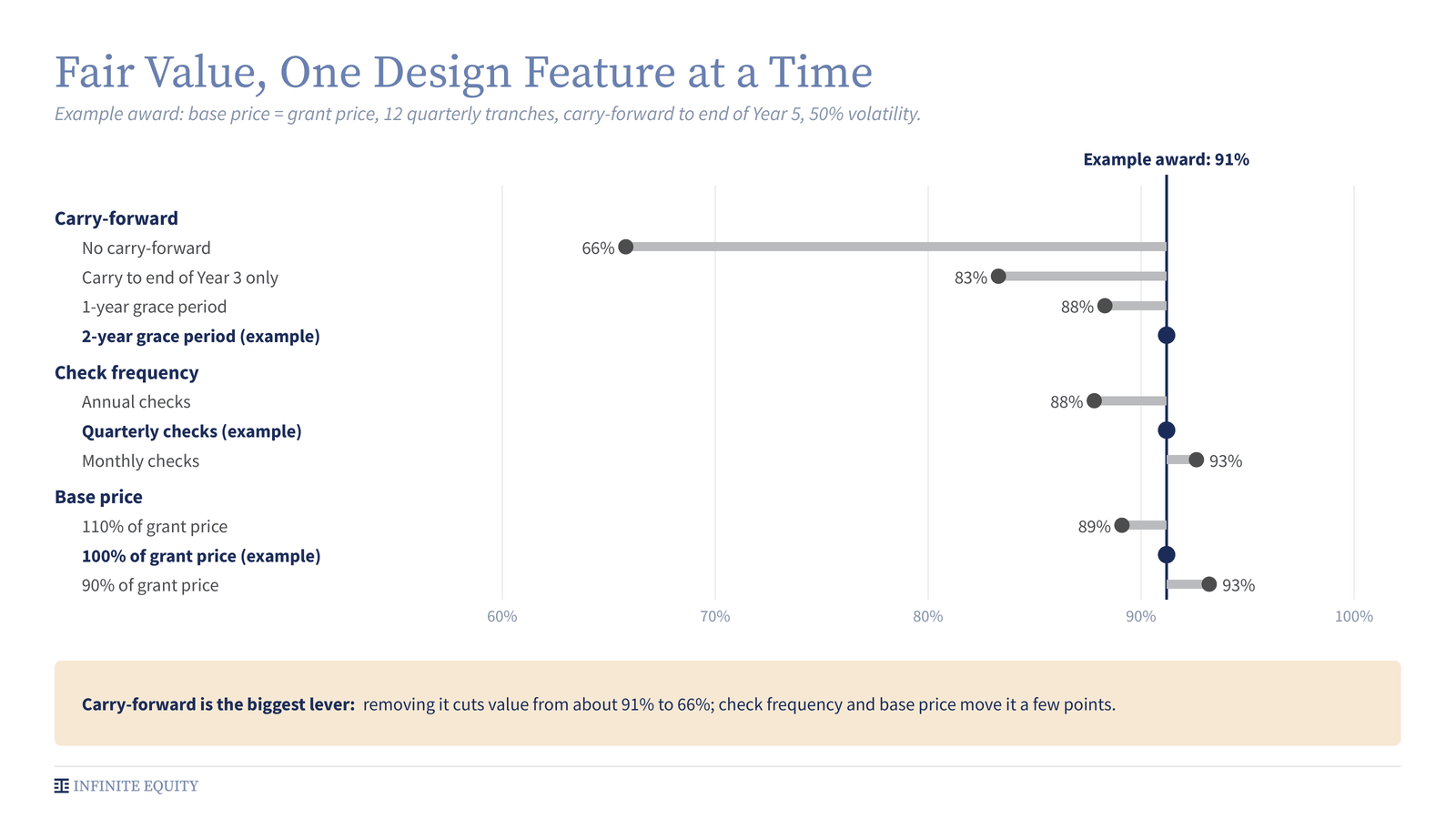
| Design feature | Setting | Fair value (% of grant-date price) |
|---|---|---|
| Carry-forward | No carry-forward | 66% |
| Carry-forward | Carry to end of Year 3 only | 83% |
| Carry-forward | 1-year grace period | 88% |
| Carry-forward | 2-year grace period (example) | 91% |
| Check frequency | Annual checks | 88% |
| Check frequency | Quarterly checks (example) | 91% |
| Check frequency | Monthly checks | 93% |
| Base price | 110% of grant price | 89% |
| Base price | 100% of grant price (example) | 91% |
| Base price | 90% of grant price | 93% |
Why each feature moves the value
- Carry-forward is the biggest lever. Without it, a missed tranche forfeits at its first failed check, and each extra check a carried tranche gets is another chance to clear, so shortening the grace period from two years to one, to none, or removing the carry-forward altogether steadily lowers the value.
- Check frequency works the same way: monthly checks give more chances than quarterly, and annual checks fewer.
- Base price sets how hard each check is. A base below the grant price binds only on a real decline; a base above it is harder to clear.
Volatility
Volatility comes from the company, not the award terms, and for this design its effect is modest. Across 30% to 70% volatility, the example award ranges from about 90% to 93%. Higher volatility raises the value slightly, because the shares that do vest tend to vest at higher prices. Without carry-forward, the range is wider, about 64% to 69%, so carry-forward also makes the award less sensitive to volatility.
The discount is a feature
Shares that would have vested at depressed prices stay unissued. They remain eligible to vest later, but some may never be issued. Companies can use the discount in one of two ways: grant more units for the same compensation expense, or book less expense for the same grant.
Expense Recognition: Front-Loaded Into Year 1
The straight-line attribution election available for time-based awards does not apply to the Price-Protected RSU. Graded, or front-loaded, attribution pulls expense into earlier periods, so the Price-Protected RSU costs less in total but books far more expense in Year 1 than a straight-line RSU.
The example: 120,000 units at $10.00 using the award above. The time-based RSU is expensed straight-line over 3 years with total expense equal to $1,200,000 (120,000 x $10.00), with $400,000 expensed each year.
The Price-Protected RSU is expensed by tranche with a total expense equal to $1,092,000 (120,000 x $10.00 x 91%, or $9.10). Each tranche is expensed from grant to its own vest date. Tranches 1–4 are fully expensed in Year 1; later tranches spread across the years they span.
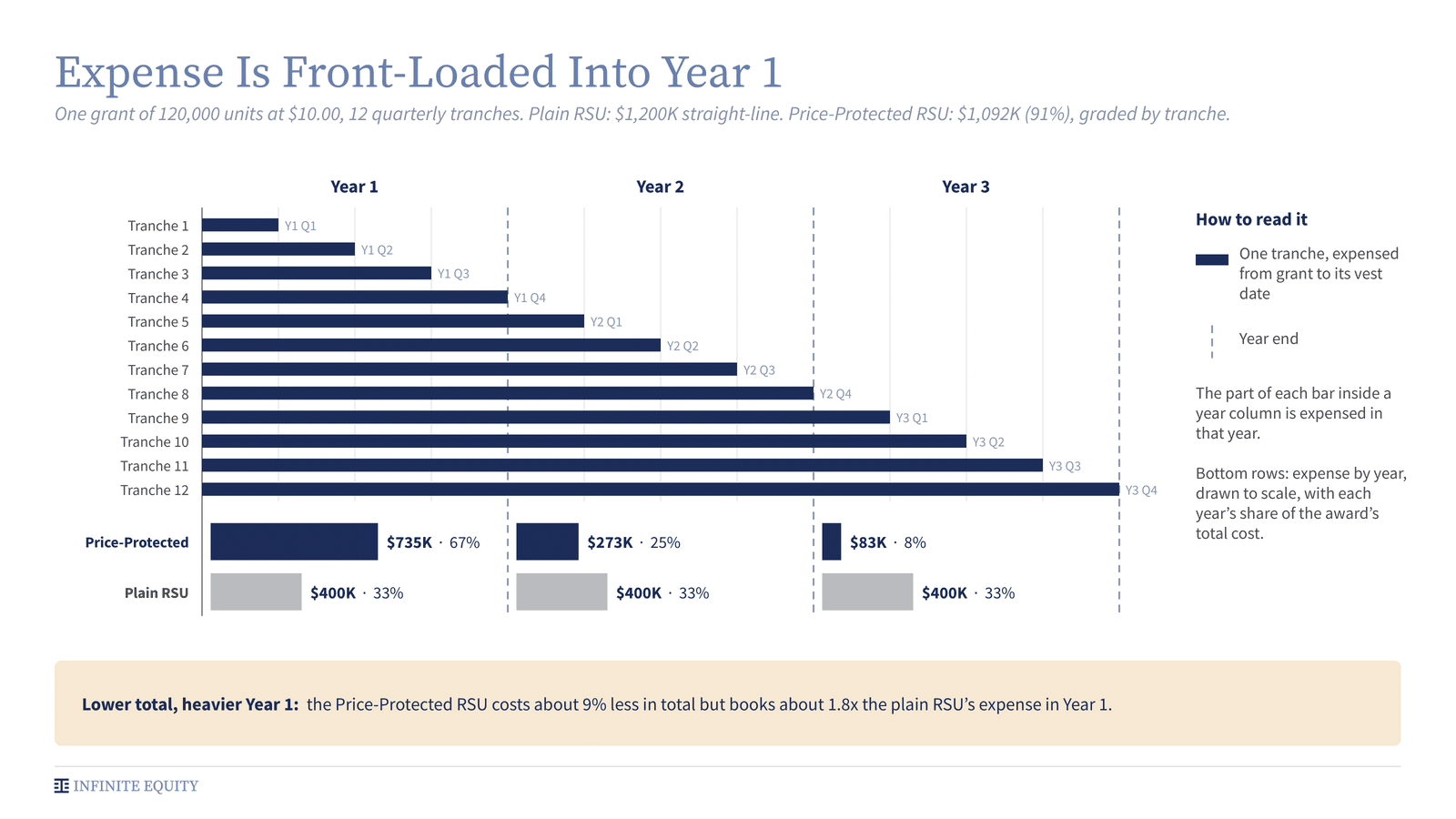
| Tranche | Vests | Total fair value | Year 1 | Year 2 | Year 3 |
|---|---|---|---|---|---|
| 1 | Year 1, Q1 | $91,000 | $91,000 | ||
| 2 | Year 1, Q2 | $91,000 | $91,000 | ||
| 3 | Year 1, Q3 | $91,000 | $91,000 | ||
| 4 | Year 1, Q4 | $91,000 | $91,000 | ||
| 5 | Year 2, Q1 | $91,000 | $72,800 | $18,200 | |
| 6 | Year 2, Q2 | $91,000 | $60,667 | $30,333 | |
| 7 | Year 2, Q3 | $91,000 | $52,000 | $39,000 | |
| 8 | Year 2, Q4 | $91,000 | $45,500 | $45,500 | |
| 9 | Year 3, Q1 | $91,000 | $40,444 | $40,444 | $10,112 |
| 10 | Year 3, Q2 | $91,000 | $36,400 | $36,400 | $18,200 |
| 11 | Year 3, Q3 | $91,000 | $33,091 | $33,091 | $24,818 |
| 12 | Year 3, Q4 | $91,000 | $30,333 | $30,333 | $30,334 |
| Price-Protected RSU total | $1,092,000 | $735,235 | $273,301 | $83,464 | |
| Plain RSU, straight-line | $1,200,000 | $400,000 | $400,000 | $400,000 |
Why Year 1 carries 67%: Tranches 1–4 land entirely in Year 1, and every later tranche puts part of its cost there too.
Longer schedules front-load even more: a five-year annual schedule recognizes nearly half its cost in Year 1, against 20% straight-line. Companies that already expense RSUs on a graded basis will see the same shape, on a smaller total. With annual grants, the gap closes as grants overlap. In this example, with a 3-year vesting schedule, the program costs less than an RSU program from Year 3, once three annual grants are layered.
What to tell the board
- Year 1 is heavy. About two-thirds of a grant’s expense lands in its first year (67% in this example).
- The total is lower and fixed at grant. There is no true-up if tranches lapse or the stock soars.
- Steady state is cheaper. Once annual grants overlap for a full vesting period (three grants in this 3-year example), run-rate expense falls below the RSU program.
- Budget on the real numbers. Forecasts need Monte Carlo tranche values and graded attribution before the grant is approved.
Implementation and Administration
If your platform already administers stock price hurdle PSUs, you are largely covered: the award is essentially a tranched PSU with a price test at each vest date. Confirm these capabilities with your vendor before the first grant.
| Capability | Why it matters |
|---|---|
| Hold a tranche after service is complete | Delivery waits on the price check |
| Re-test later and release several tranches at once | Carried tranches settle together when a check clears |
| Eligibility end dates | Carried tranches lapse at final expiration and return to the reserve |
| Termination rule for carried tranches | Most designs forfeit them on exit |
| Graded expense from per-tranche values | Straight-line is not permitted |
No re-test capability? Each tranche can be set up as its own performance grant, at the cost of more records.
What to track
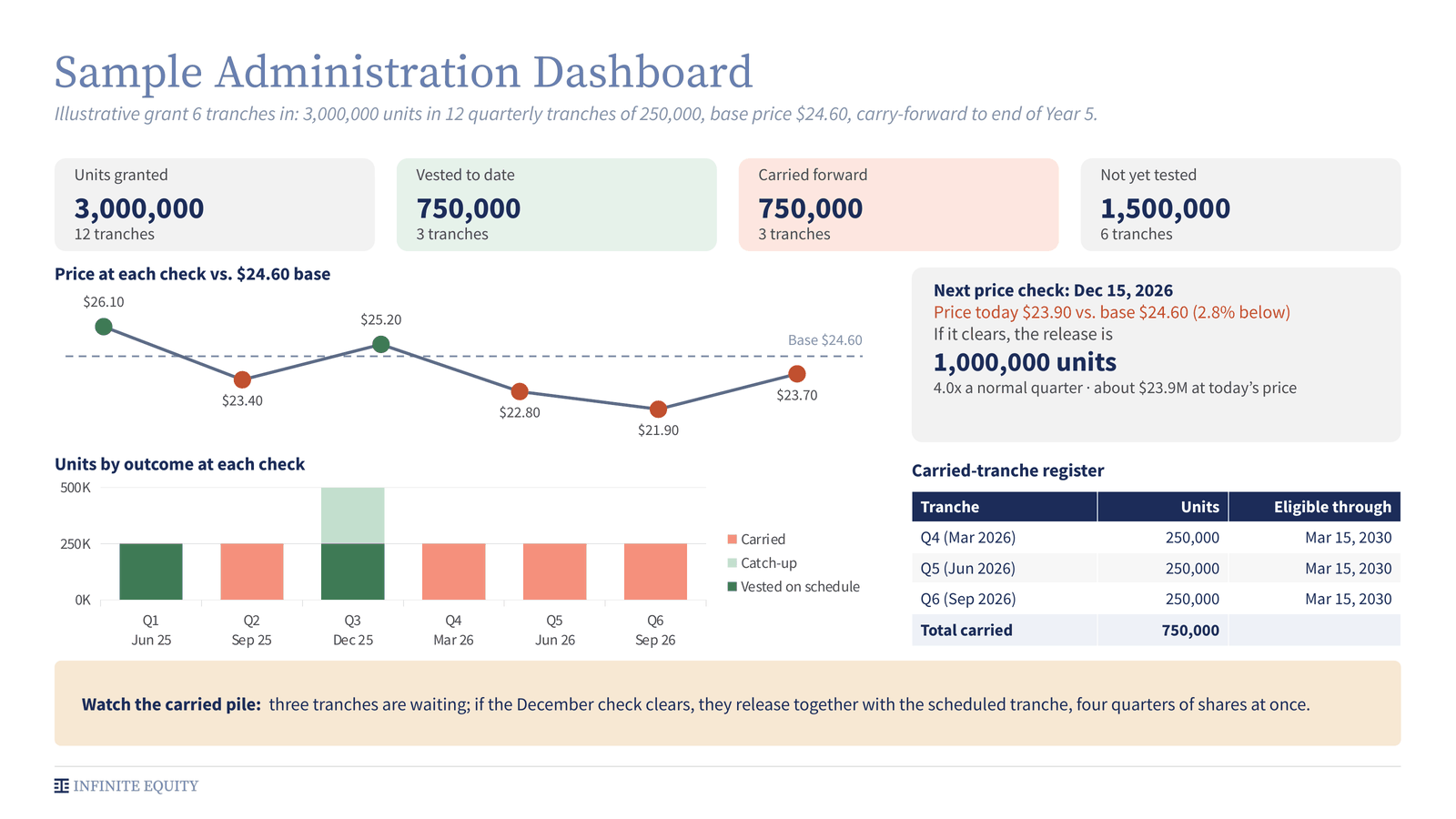
- Price-check log: date, price source, method, result, and sign-off for every check, since auditors will test it.
- Carried-tranche register: units, original vest date, and eligible-through date.
- Settlement forecast: what releases if the next check clears, with withholding. A catch-up can be several quarters of shares at once.
- Participant notices: what carried after each missed check, and when the next check is.
- Tax review: employment-tax timing for carried tranches and Section 409A treatment of the grace period.
A single dashboard can answer most questions from finance, the committee, and participants:
Before the First Grant
- Run the Monte Carlo on the actual award terms, including carry-forward and grace period.
- Rebuild the expense forecast on graded attribution for at least as many annual grant cycles as the vesting period (three in this example).
- Agree classification, valuation inputs, and the requisite service period with auditors.
- Confirm the platform can hold, re-test, and release tranches.
- Set up the price-check log, carried-tranche register, and participant notices.
- Confirm employment-tax and Section 409A treatment with tax advisors.
Closing Thoughts
Finance and administration teams that already handle stock price hurdle PSUs have what they need for the Price-Protected RSU. What deserves attention is the size of the effects: removing carry-forward can cut grant-date value from about 91% to 66% in our example, and graded attribution can bring Year 1 expense to about 1.8 times a straight-line RSU. Both are known before the first grant, if the design is modeled first.
In our next article, we turn to executive awards: how the price check fits long-vesting designs and what shareholders and proxy advisors will look for.
Frequently Asked Questions
A Price-Protected RSU’s price check is a market condition under ASC 718, which must be reflected in grant-date fair value. Because the outcome depends on the stock’s path across many check dates, simulation is the practical way to value it.
No. Because the price check is a market condition under ASC 718, expense stands once service is rendered, whether or not the stock ever clears the base price. It is reversed only for employees who leave before completing the required service.
Each tranche is expensed as a separate award from grant to its own vest date, and straight-line attribution is not available. Early tranches are fully expensed in Year 1, and later tranches put part of their cost there too. In our example of 12 quarterly tranches over three years, Year 1 carries 67% of total expense, against 33% for a straight-line RSU.
No. In our modeling of an award with the base price set at the grant price and a two-year grace period, higher volatility slightly raises the value, from about 90% of the grant-date price at 30% volatility to about 93% at 70%. Design terms such as carry-forward and the grace period move the value far more.
Follow Along
This is the third article in a 6-part series on the Price-Protected RSU. Enter your details below and we’ll send each new article straight to your inbox.
About the Authors

Jon Burg
Managing Partner
Jon Burg is Managing Partner and a practice leader at Infinite Equity, based in San Francisco. He works with companies to build equity programs that support long-term employee ownership, from initial design through full execution. With more than 20 years in the field and an actuarial background, he brings added rigor to how equity compensation programs are designed, valued, and implemented. Jon is a graduate of the University of Washington.

Daniella Butler, FSA, CEP
Managing Director
Daniella Butler is a Managing Director at Infinite Equity in New York City. She holds the FSA (Fellow of the Society of Actuaries) and CEP designations and has spent more than 10 years advising on compensation and benefits, with particular expertise in equity strategy, design, and valuation. She is a graduate of Hofstra University.
- FASB ASC 718-10-30-14. The effect of a market condition is reflected in the award’s grant-date fair value, and compensation cost is recognized for an employee who renders the requisite service, regardless of when, if ever, the market condition is satisfied. ↩︎
- FASB ASC 718-10-35-8 permits a policy choice between straight-line and graded attribution only for graded-vesting awards with service conditions alone. Awards with market or performance conditions use graded attribution. ↩︎
- FASB ASC 718-10-55-73. For an award with a market condition, the requisite service period is generally the longest of the explicit, implicit, and derived service periods. ↩︎
- Infinite Equity Monte Carlo model, October 2026: 50% volatility, 4.5% risk-free rate, 200,000 paths per scenario. Values for other designs and volatilities cited in this article come from the same model. ↩︎